Rechercher dans ce blog

Monday, February 28, 2022

Apple hit with sixth antitrust fine over Dutch dating apps payments - TechCrunch

TechCrunch is part of the Yahoo family of brands.

By clicking "Accept all" you agree that Yahoo and our partners will store and/or access information on your device through the use of cookies and similar technologies and process your personal data, to display personalised ads and content, for ad and content measurement, audience insights and product development.

Your personal data that may be used

  • Information about your device and internet connection, including your IP address
  • Browsing and search activity while using Yahoo websites and apps
  • Precise location

You can select 'Manage settings' for more information and to manage your choices. You can change your choices at any time by visiting Your Privacy Controls. Find out more about how we use your information in our Privacy Policy and Cookie Policy. Click here to find out more about our partners.

Adblock test (Why?)


Apple hit with sixth antitrust fine over Dutch dating apps payments - TechCrunch
Read More

Russia suspended from international soccer over Ukraine invasion, will miss World Cup - CNBC

Russia's Aleksandr Erokhin in action with Cyprus' Grigoris Kastanos, Gazprom Arena, Saint Petersburg, Russia, November 11, 2021.
Anton Vaganov | Reuters

Russia's soccer teams were suspended indefinitely from international competition by major governing bodies Monday because of the country's invasion of Ukraine.

The ban means that Russia's national team will be blocked from playing in the 2022 World Cup.

Russia had been set to compete soon for one of the slots allocated to European nations in that quadrennial competition, which will be held in Qatar.

The suspension from international play was imposed jointly on Russia's national squad and on club teams by FIFA, the world-wide governing body for soccer, and UEFA, which oversees European soccer.

Before Monday's announcement, FIFA had faced criticism on Sunday for a decision to allow Russia to continue competing for a World Cup slot. Russia had been set to play Poland next month in a play-off.

In a joint statement Monday, the groups said, "Following the initial decisions adopted by the FIFA Council and the UEFA Executive Committee, which decisions envisaged the adoption of additional measures, FIFA and UEFA have today decided together that all Russian teams, whether national representative teams or club teams, shall be suspended from participation in both FIFA and UEFA competitions until further notice."

"Football is fully united here and in full solidarity with all the people affected in Ukraine," the groups said. "Both Presidents hope that the situation in Ukraine will improve significantly and rapidly so that football can again be a vector for unity and peace amongst people."

Adblock test (Why?)


Russia suspended from international soccer over Ukraine invasion, will miss World Cup - CNBC
Read More

Sunday, February 27, 2022

Men's Lacrosse: Norwich Opens Season with 13-10 Victory over Plymouth State - Norwich - norwichathletics.com

Adblock test (Why?)


Men's Lacrosse: Norwich Opens Season with 13-10 Victory over Plymouth State - Norwich - norwichathletics.com
Read More

How hot is the real estate market in Story County? Home prices rose year over year - Ames Tribune

Saturday, February 26, 2022

Mickelson Losing Corporate Relationships Over Saudi Remarks - U.S. News & World Report

[unable to retrieve full-text content]

Mickelson Losing Corporate Relationships Over Saudi Remarks  U.S. News & World Report
Mickelson Losing Corporate Relationships Over Saudi Remarks - U.S. News & World Report
Read More

Facebook, Apple and Other Tech Giants Face Rising Pressure Over Ukraine - The Wall Street Journal

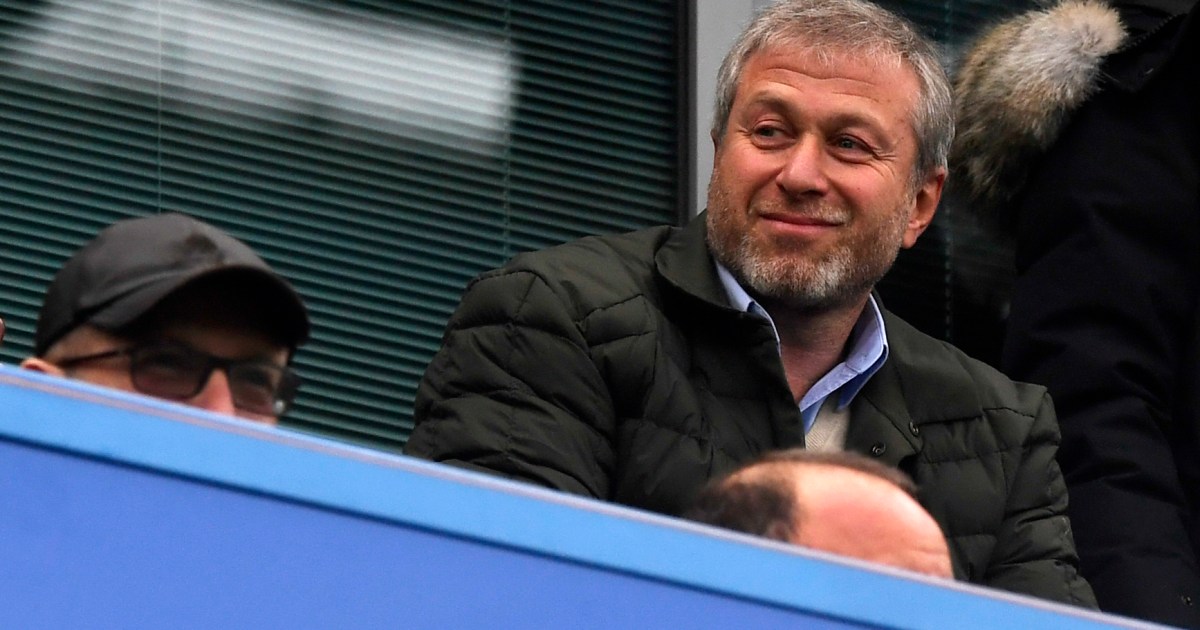
Abramovich hands over control of Chelsea to club’s foundation - Al Jazeera English

English football club’s Russian owner says he is handing over stewardship of Premier League team to trustees of its charitable foundation.

Chelsea’s Russian owner Roman Abramovich said he is handing over the “stewardship and care” of the Premier League club to the trustees of its charitable foundation.

The move comes with Russia under intense scrutiny following its invasion of Ukraine this week.

Billionaire Abramovich, who took over at Stamford Bridge in 2003, said in a statement on Saturday: “During my nearly 20-year ownership of Chelsea FC, I have always viewed my role as a custodian of the club, whose job it is ensuring that we are as successful as we can be today, as well as build for the future, while also playing a positive role in our communities.

“I have always taken decisions with the club’s best interest at heart. I remain committed to these values. That is why I am today giving trustees of Chelsea’s charitable foundation the stewardship and care of Chelsea FC.

“I believe that currently they are in the best position to look after the interests of the club, players, staff, and fans.”

Abramovich took the decision in order to protect Chelsea from reputational damage as war rages in Ukraine, news reports say.

The Telegraph newspaper reported Abramovich will remain the owner of the club and is not looking to sell the European champions.

Chelsea chairman Bruce Buck is also chair of the club’s foundation.

Thomas Tuchel, the team’s manager, admitted on Friday that uncertainty over Abramovich’s future as owner was weighing on his club ahead of Sunday’s League Cup final against Liverpool.

“We should not pretend this is not an issue,” he said. “The situation in general for me and for my staff, the players, is horrible.

“Nobody expected this. It’s pretty unreal, like I said it’s clouding our minds, it’s clouding our excitement towards the final.”

Earlier in the week, using parliamentary privilege, Liberal Democrat member of Parliament Layla Moran named Abramovich as one of 35 “key enablers” to Russian leader Vladimir Putin who should be sanctioned.

The United Kingdom government on Friday ordered all assets of Putin and his Foreign Minister Sergey Lavrov frozen over Russia’s invasion of Ukraine.

The Treasury issued financial sanctions notice against the two men, adding them to a list of Russian oligarchs who have already had their property and bank accounts in the UK frozen.

Abramovich is not on the list.

The UK is a favourite destination for oligarchs and their families and has been criticised for not doing enough to prevent the flow of their money into the country.

Abramovich has supplied Chelsea with 1.5 billion pounds ($2bn) worth of funding over the past 19 years.

Chelsea FC have enjoyed a period of unprecedented success as a result, winning five Premier League titles and two Champions League crowns among a vast haul of silverware since he took over the club.

Portugal granted citizenship to the 55-year-old in December, and he has also been granted Israeli citizenship.

Abramovich is worth nearly $14bn according to Forbes. He ranked 142nd on the magazine’s 2021 list of the globe’s billionaires.

Adblock test (Why?)


Abramovich hands over control of Chelsea to club’s foundation - Al Jazeera English
Read More

Friday, February 25, 2022

Valery Gergiev Faces Removal From Podiums Over Support for Putin - The New York Times

A day after he was dropped from concerts at Carnegie Hall, the star Russian maestro Valery Gergiev on Friday faced rising anger over his record of support for President Vladimir V. Putin of Russia, with several leading European institutions — including the Munich Philharmonic, of which Mr. Gergiev is chief conductor — threatening to sever ties with him unless he denounced Mr. Putin’s invasion of Ukraine.

The fallout, encompassing Germany, Italy and the Netherlands, was a rare rebuke of a titan of the classical music industry, and it reflected growing global outrage over Mr. Putin’s ongoing military offensive in Ukraine.

Mr. Gergiev, 68, one of Russia’s most prominent cultural ambassadors, is now being shunned because of his ties to Mr. Putin, his longtime friend and benefactor. He seems in peril of losing several key posts, including the podium in Munich and his position as honorary conductor of the Rotterdam Philharmonic Orchestra.

Munich’s mayor, Dieter Reiter, issued an ultimatum on Friday, saying Mr. Gergiev must denounce the “brutal war of aggression that Putin is waging against Ukraine” before Monday or be fired by the orchestra, three years before his contract is set to expire.

The Rotterdam Philharmonic Orchestra offered a similar warning, threatening to cancel its “Gergiev Festival,” planned for September. The Teatro alla Scala in Milan said Mr. Gergiev would be dropped from upcoming performances of Tchaikovsky’s “Queen of Spades” and other engagements if he did not immediately call for peace.

And after Carnegie Hall and the Vienna Philharmonic announced on Thursday that Mr. Gergiev would no longer lead the orchestra in three high-profile concerts starting Friday evening, Carnegie on Friday canceled two concerts by the Mariinsky Orchestra in May that were to have been led by Mr. Gergiev.

Mr. Gergiev did not respond to requests for comment from The New York Times.

The uproar was a significant blow to a conductor who has built a busy international career while maintaining deep ties to the Russian state, including in his role as general and artistic director of the Mariinsky Theater in St. Petersburg.

Mr. Putin has been critical to Mr. Gergiev’s success, providing funding to his theater and showering him with awards. Mr. Gergiev has emerged as a prominent supporter of Mr. Putin, endorsing his re-election and appearing at concerts in Russia and abroad to promote his policies. The two have known each other since the early 1990s, when Mr. Putin was an official in St. Petersburg and Mr. Gergiev was beginning his tenure as the leader of the Mariinsky, then called the Kirov.

Western cultural institutions have largely looked beyond Mr. Gergiev’s ties to Mr. Putin, even as the conductor became the target of repeated protests over the past decade, at Carnegie, the Metropolitan Opera and elsewhere.

Mr. Putin’s invasion of Ukraine this week put new pressure on arts leaders to reconsider their ties to Mr. Gergiev. After a hastily arranged meeting on Thursday morning, Carnegie Hall and the Vienna Philharmonic made the announcement that the orchestra would go on without him. The Russian pianist Denis Matsuev, who had been scheduled to perform with Mr. Gergiev and the Philharmonic on Friday, and who has expressed support for Mr. Putin’s policies in the past, was also taken off the program.

Clive Gillinson, Carnegie’s executive and artistic director, who in the past said that Mr. Gergiev should not be punished for political views, said in an interview on Friday that he and the Philharmonic had come to the conclusion that it was “untenable” for Mr. Gergiev and Mr. Matsuev to perform because of their ties to Mr. Putin.

“All of us felt this situation just changes the world, unfortunately,” he said, referring to the invasion of Ukraine.

Mr. Gergiev and Mr. Matsuev were also dropped from concerts next week in Naples, Fla., with the Philharmonic, whose chairman said as recently as Sunday that Mr. Gergiev was a gifted artist and would take the podium for the Carnegie dates.

“He’s going as a performer, not a politician,” Daniel Froschauer, the orchestra’s chairman, said in an interview then with The Times.

The Philharmonic issued a statement on Friday saying it stands against “every form of aggression and war.” It did not reference Mr. Gergiev or Mr. Matsuev.

The attack on Ukraine prompted Anna Netrebko, the Russian soprano who is one of the biggest stars in opera, to cancel a performance she had been set to give Friday night in Denmark with her husband, the tenor Yusif Eyvazov.

Adblock test (Why?)


Valery Gergiev Faces Removal From Podiums Over Support for Putin - The New York Times
Read More

Finnish hockey team leaves KHL playoffs over Ukraine invasion - ESPN

Jokerit has decided to end its season rather than appear in the Kontinental Hockey League playoffs following Russia's invasion of Ukraine this week.

The Finland-based team was scheduled to face Moscow's Spartak in the first round of the Gagarin Cup playoffs on March 1. The league said it will revise the Western Conference playoff bracket.

Jari Kurri, the chairman of Jokerit, made the decision to suspend the team's 2021-22 season and said that "the current global situation" made it impossible to compete in the KHL playoffs.

"My position on the end of the season was clear right on Thursday morning," Kurri said. "The world is going through really difficult times right now. All our thoughts are with the people suffering from the situation. We hope that a peaceful solution to the situation can be found soon."

Jokerit has been a member of the KHL since the 2014-15 season and was the second-best team in the Western Conference this season.

"We're very sorry to lose Jokerit, an excellent and vibrant team, with a recognizable style," said Alexei Morozov, KHL president. "It's very unfortunate that the Jokerit's departure is due not to sporting reasons, but to political ones."

The move from Jokerit comes amid pressure from its fans and sponsors. Helsinki Jokers fan group "Eteläpääty ry" issued a news release on Feb. 22 that demanded the team withdraw from the KHL. "Continuing the games will cause immeasurable damage to the entire club, which may never be repaired again," it said.

According to Finnish television station MTV, via YLE, several Jokerit sponsors have announced they are terminating their partnerships with the team. Hartwall, the title sponsor of their arena, has questioned its commitment and cited "Russia's military actions in Ukraine" as the reason.

Jokerit, based in Helsinki, is one of five KHL teams situated outside of Russia. Dinamo Minsk of Belarus, Dinamo Riga of Latvia, Barys Nur-Sultan of Kazakhstan and Red Star Kunlun of Beijing are the others. Kunlun has played the past two seasons based just outside of Moscow because of the COVID-19 pandemic.

Adblock test (Why?)


Finnish hockey team leaves KHL playoffs over Ukraine invasion - ESPN
Read More

EU to freeze Putin, foreign minister assets over Ukraine attack - Al Jazeera English

The EU has agreed to freeze European assets linked to Russian President Vladimir Putin and Foreign Minister Sergey Lavrov over their decision to invade Ukraine, EU officials said on Friday.

EU foreign ministers were meeting in Brussels to thrash out details and formally approve the sanctions, described as the harshest ever imposed by the bloc.

“We are hitting Putin’s system where it has to be hit, not only economically and financially, but also at the heart of its power,” German Foreign Minister Annalena Baerbock said as she arrived for a meeting in Brussels with EU counterparts.

That is why “we now list also the president, Mr Putin, and Foreign Minister Lavrov” to a packet of new sanctions agreed by EU leaders overnight, she said.

Latvian Foreign Minister Edgars Rinkevics tweeted the 27-nation bloc’s foreign ministers adopted the sanctions package and “the asset freeze includes President of Russia and its Foreign Minister”.

Austrian Foreign Minister Alexander Schallenberg said the move would be “a unique step in history toward a nuclear power, a country that has a permanent seat on the Security Council, but also shows … how united we are”.

It was unclear what the practical impact on Putin and Lavrov would be and how important their assets in the EU were.

An equally big move would be to ban Putin and Lavrov from EU travel. But EU leaders have made it clear that would be off the table for now, since it might complicate diplomatic moves once all sides get around the negotiating table.

Earlier on Friday, Zelenskyy urged Europe to act more quickly, accusing Western allies of politicking as Moscow’s forces advanced on Ukraine’s capital Kyiv.

“You still can stop this aggression. You have to act swiftly,” he said, adding that banning Russians from entering the EU, cutting Moscow off from the SWIFT global interbank payments system, and an oil embargo should all be on the table.

Devastating effect

The EU sanctions hammer Russia’s financial, energy and transport sectors, curb the ability of Russians to keep large amounts of cash in EU banks, and greatly expand the number of Russians on the EU’s list of individuals barred from entering the bloc’s 27 countries and freezing any EU assets.

But the measures stopped short of kicking Russia out of the SWIFT messaging system used globally by banks to arrange transfers, a major step that has been used to devastating effect against Iran.

While Ukraine’s beleaguered government is lobbying ferociously for the EU to pull the trigger on a SWIFT ban for Russia, several EU countries, most notably Germany, which has to pay Russia for natural gas, are reluctant.

An asset freeze directed at Putin and Lavrov, both said by anti-corruption campaigners to have amassed immense wealth, has strong symbolic impact. But it was unclear how European authorities could identify their assets with legal certainty.

Hitting ‘prime architects’

The bloc is also expected to change visa rules, restricting the entry of government-related business people.

EU’s Josep Borrell admitted he “personally” is “very much in favour” of sanctioning Putin and Lavrov, but the final decision is for EU foreign ministers to take.

Dutch Foreign Minister Wopke Hoekstra said “prime architects of this endeavour, of this darkness” must be targeted.

Irish Foreign Minister Simon Coveney said adding Putin and Lavrov’s names “is absolutely appropriate, given who the key decision-makers are to actually wage war on Ukraine”.

However, Ukraine’s Foreign Minister Dmytro Kuleba tweeted angrily, “let’s not let the EU get away with pretending that assets bans on Putin and Lavrov can make up for real action.”

“To some European leaders who are still hesitant: each year at commemorative events you say ‘Never again’. The time to prove it is now,” he said, demanding the bloc ban Russia from SWIFT.

Germany’s chancellor, Olaf Scholz, said on Thursday his country preferred to keep the SWIFT option in reserve.

Baerbock said on Friday, “Words like agreement on SWIFT sound very tough, but in these moments, you have to keep a cool head.”

She argued it would disproportionately hurt people like “a granddaughter living in Europe who wants to transfer money to her grandmother in Russia”.

Those “responsible for the bloodshed” would have alternative ways of getting around a SWIFT ban, she said.

Undeterred in the game of punitive sanctions, Russia started its own tit-for-tat measures, banning British flights to and over its territory in retaliation for a similar UK ban on Aeroflot flights.

Russian authorities also announced the “partial restriction” of access to Facebook after the social media network limited the accounts of several Kremlin-backed media.

Russian state communications watchdog Roskomnadzor said it demanded that Facebook lift the restrictions it placed Thursday on state news agency RIA Novosti, state TV channel Zvezda, and pro-Kremlin news sites Lenta.Ru and Gazeta.Ru.

Adblock test (Why?)


EU to freeze Putin, foreign minister assets over Ukraine attack - Al Jazeera English
Read More

Thursday, February 24, 2022

Image shows empty airspace over Ukraine and its border with Russia - CNN

(CNN) — The airspace over Ukraine and its border with Russia is empty, according to flight tracking websites, with heavy air traffic apparently avoiding the region as evening sets in on Thursday, local time.

Images from ADS-B Exchange show no aircraft over Ukraine, though the open-source site cannot display tracking data from aircraft operating in the area with the location broadcasting intentionally switched off.

Civilian flights over Ukraine, as well as Moldova to the south and parts of Russia, are currently restricted. One notice to pilots reads: "Air space of Ukraine closed for civil aviation flights due to military invasion of Russian Federation."

The European Union Aviation Safety Agency, or EASA, warned Thursday: "The presence and possible use of a wide range of ground and airborne warfare systems poses a HIGH risk for civil flights operating at all altitudes and flight levels.

There are also risks to flying over conflict zones -- as illustrated by the 2014 downing of Malaysia Airlines flight 17 over eastern Ukraine by a missile, killing 298 people.

Western officials and a Dutch-led investigation said Russian president Vladimir Putin bears responsibility for the incident; Putin denied it.

Adblock test (Why?)


Image shows empty airspace over Ukraine and its border with Russia - CNN
Read More

Mask mandates ending March 19, with state of emergency over April 1 – Oregon Capital Chronicle - Oregon Capital Chronicle

The last of the pandemic limits Oregonians have endured for nearly two years are ending, with state authorities lifting mask requirements by Friday, March 19, and the state of emergency ending April 1, state officials announced Thursday.

That means that this spring, life in Oregon will officially be back to normal though the virus is not going away. But the announcements indicate that state officials think that it is time that Oregonians live with the risk of Covid the same way they cope with influenza or cold viruses.

“Lifting Oregon’s Covid-19 emergency declaration today does not mean that the pandemic is over, or that Covid-19 is no longer a significant concern.” Gov. Kate Brown said in a statement. “But, as we have shown through the delta and omicron surges, as we learn to live with this virus, and with so many Oregonians protected by safe and effective vaccines, we can now protect ourselves, our friends, and our families without invoking the extraordinary emergency authorities that were necessary at the beginning of the pandemic.”

Masks won’t be required in either schools or indoor public places after March 19, about two weeks earlier than expected. The Oregon Health Authority had set March 31 as the end date, but said if hospitalizations of people with Covid drop to 400 sooner, it would lift the indoor mask mandate sooner. 

The health authority said in a statement Thursday that hospitalizations are expected to reach 400 by March 20. That is based on the latest forecast from the Oregon Health & Science University, the agency said.

The statement said that preparations in schools were advancing more quickly than expected, which allowed the state to lift that mandate earlier than March 31. 

“We are able to take this important step, earlier than anticipated, because of the collective diligence and the shared sacrifice that people in Oregon have demonstrated in getting vaccinated, wearing masks and limiting their gatherings,” Dr. Dean Sidelinger, the state health officer and epidemiologist, said in a statement.

Brown echoed that sentiment in her statement: “Over the past six months, as Oregon weathered our worst surges of the pandemic (and) I’m proud of the way Oregonians have worked together to keep each other safe.” 

Mask mandates will remain in effect in health care facilities — and in correctional settings, according to the Salem Reporter. An email from Katy Coba, chief operating officer and director of Oregon’s Department of Administrative Services, also said that state office buildings that have been closed to the public will reopen May 1.

“We strongly encourage all employees to take any necessary steps they deem appropriate to protect themselves, their family, their co-workers and their community from Covid-19, Coba said in the email. “If any employee would like to continue to wear a mask in their workplace, they are welcome to and are fully supported in doing so. Embracing a positive and respectful workplace has always been a priority for state employees and will need to become an even higher priority as more employees return to the workplace.”

The end of the mandates and state of emergency will not lift vaccination requirements for health care workers and K-12 educators, Brown said in her statement. Those requirements were put in place by state or federal non-emergency authority, the statement said.

Oregon is one of the last states to lift mask mandates. Washington Gov. Jay Inslee said earlier this month that he would lift his state’s indoor mask mandate on March 21, a day after the first day of spring this year.

Most Oregonians are not likely to notice the end of the governor’s state of emergency. The emergency order, put in place on June 30, provided the state flexibility to respond to the pandemic by mobilizing volunteer medical professionals in hospitals, including many who are retired. The order also gave the state the ability to loosen medical license standards to bring in more nurses, for example. And it gave Oregon access to emergency federal funds, including enhanced benefits for people receiving food assistance.

Most of the governor’s executive orders on Covid were rescinded last year. Brown did mobilize the Oregon National Guard again in January, deploying 1,200 troops to 40 hospitals and medical centers around the state. They were mobilized for 90 days. Ursulla Bischoff, chief, civic engagement for the Oregon Military Department, said troops will demobilize at the end of March.

That’s still the plan,” said Bischoff said.

Infections have fallen rapidly in recent weeks. Over the past month, new infections have declined by more than 80%. The seven-day moving average is now 1,147 cases a day – 84% lower than at the peak of the omicron surge.

Daily Covid hospitalizations also have dropped nearly 50% since peaking in late January. Over the past two weeks, hospitalizations have fallen by an average of more than 30 a day, the health authority said. 

On Wednesday, 579 people were hospitalized with Covid around the state.

“Our hospitals are still dealing with elevated patient populations,” Sidelinger said in a video statement. “But the data tell us that the stress on our hospital system is clearly easing. Contingency planners can now turn their attention to eventually drawing down the additional outside resources, such as nurse staffing, that were needed to provide patient care.”

The Oregon Health Authority has contracted with temporary staffing agencies, hiring about 1,000 nurses, certified nursing assistants and other professionals to work in hospitals.

State officials said that three weeks is enough time for local communities and school districts to prepare for lifting the mask mandates.

Colt Gill, director of the Education Department, said in a statement that education and health officials were working on updating safety protocols for quarantine, contact tracing and testing to match the current state of the pandemic.

“These guidelines will continue to support our North Star goal of providing in-person learning for every student, all day, every school day and will focus on specific supports for students, staff, and families that may be at more risk from Covid-19 than others in the school population,” Gill said in a statement.

Some schools have already lifted the mask mandate or said they would do so soon, defying state officials.

In the Alsea School District near Corvallis, the local school board and then-Superintendent Marc Thielman made masks optional on Jan. 31. In response, the state Education Department froze the district’s federal Covid relief dollars. 

Thielman recently resigned to run for governor.

The district is currently under investigation by the state’s Occupational Safety and Health Administration and could face fines of up to $500 for each day the mask mandate is violated.

Though the mandate will be lifted, the Education Department still recommends that schools continue to enforce masking after March 19. Districts that choose to make masks optional will sacrifice their access to the test-to-stay program that had allowed unvaccinated students to stay in school even after an exposure. Without a mask requirement in schools, unvaccinated students will need to quarantine immediately after an exposure, the state said Thursday.

“Those settings bring together vaccinated and unvaccinated individuals, as well as individuals who are at higher risk for severe Covid-19 illness,” the Oregon Health Authority said in its statement.

Many schools are likely to not require masks.

Chris Fritsch, superintendent in Pendleton, said after gathering school and community feedback, they’ll make masks optional after the mandate. “We have polled staff, parents and students. By large majorities most will be opting not to wear a face covering when it becomes optional,” Fritsch said.

But others said they would wait for updated guidance from the Department of Education and Oregon Health Authority next week, when there will be a revised “Ready Schools, Safe Learners Resiliency Framework” that advises schools on how to stay safe and stay open. Ryan Noss, superintendent in the Corvallis School District, said his district will wait for the updates to make a decision.
“Keeping our school open and students in our classrooms will remain the priority in any decision,” Noss said.

State officials also recommend that people in high-risk groups continue to wear masks in indoor public settings after the restrictions are lifted. They include people who are not vaccinated, have underlying health conditions that put them at risk for severe disease, are 65 or older or live with someone in those categories.

Reporter Alex Baumhardt contributed to this report.

Adblock test (Why?)


Mask mandates ending March 19, with state of emergency over April 1 – Oregon Capital Chronicle - Oregon Capital Chronicle
Read More


Biden unveils new Russia sanctions over Ukraine invasion - Al Jazeera English

Washington, DC – United States President Joe Biden has announced new sanctions against Russia, vowing to impose a “severe cost” on the country for its invasion of Ukraine.

Speaking from the White House on Thursday, Biden voiced support for Ukraine and said the sanctions package will limit international trade with Moscow and penalise Russian President Vladimir Putin’s inner circle.

“Putin is the aggressor; Putin chose this war, and now he and his country will bear the consequences,” Biden said.

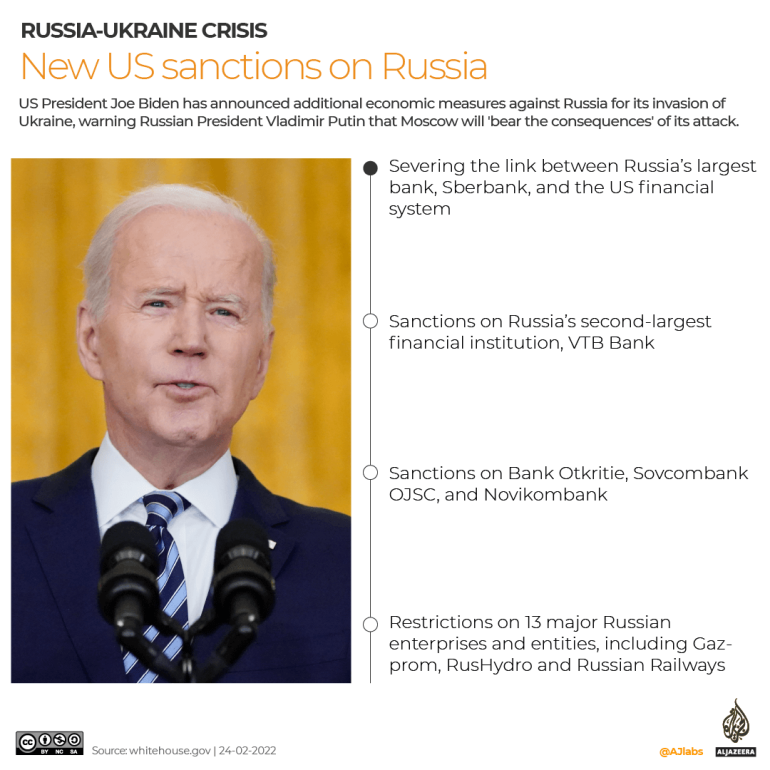
The sanctions target four Russian banks that hold more than $1 trillion in assets, including the country’s largest bank, Sberbank. “That means every asset they have in America will be frozen,” the US president said.

Biden also said the sanctions will target wealthy Russians close to Putin. “We will keep up this drumbeat of those designations against corrupt billionaires in the days ahead,” he pledged.

Thursday’s measures did not target the Russian president personally, but Biden said sanctioning Putin is “on the table”.

The US move comes after Russia launched a large-scale military operation in Ukraine late on Wednesday after a months-long impasse in the region that saw Moscow amass as many as 200,000 troops near the Ukrainian border.

European countries began imposing sanctions on Russia over the invasion on Thursday, with the United Kingdom announcing measures targeting dozens of Russian banks, businesses and wealthy elites, and banning Russia’s national airline Aeroflot from the country’s airspace.

Putin said Russia is aiming for the “demilitarisation and denazification of Ukraine” but does not plan on occupying the country. Russian forces bombed targets across Ukraine throughout the night.

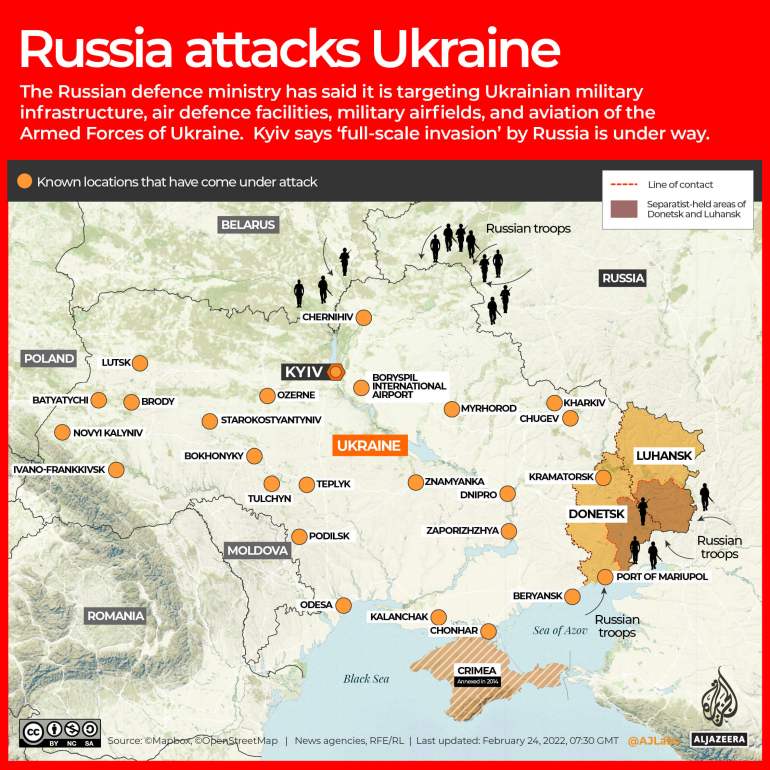
Ukrainian officials have said fighting also is taking place on the ground, with Russian forces on Thursday capturing the former nuclear power plant in Chernobyl, in the country’s north.

Ukrainian President Volodymyr Zelenskyy declared martial law late on Wednesday, and pledged that Ukrainians would defend themselves against the invasion. “When you will be attacking us, you will see our faces, not our backs, but our faces,” Zelenskyy said.

Putin had accused the Ukrainian government of committing atrocities in the east of the country where government forces had been battling Russia-backed separatists since 2014, but Ukrainian officials have repeatedly denied attacking the pro-Moscow rebels.

An infographic details new US sanctions on Russia

Russia initially denied US and European allegations that it was planning to invade Ukraine, insisting that it has legitimate security concerns over Kyiv’s deepening alliance with the West – and demanding guarantees that Ukraine will not be allowed to join NATO.

Numerous rounds of talks between Russian, European and American officials had failed to end the impasse. US and European officials had argued that NATO is a defensive alliance that does not pose a threat to Russia, stressing that it would be a violation of Kyiv’s sovereignty to allow Moscow to veto its efforts to join.

Before Biden’s announcement, US lawmakers from both major parties had condemned the Russian invasion of Ukraine and called for swift and “painful” sanctions against Moscow.

Asked whether the sanctions failed to stop Putin from invading Ukraine, Biden said on Thursday: “The threat of the sanctions – and imposing the sanctions and seeing the effects of the sanctions – are two different things.”

Biden also said his administration will work to stablise the energy market and minimise the effects of the crisis on fuel costs in the US. Russia is one of the world’s top producers of oil and natural gas.

“I know this is hard and that Americans are already hurting. I will do everything in my power to limit the pain the American people are feeling at the gas pump,” Biden said. “But this aggression cannot go unanswered. If it did, the consequences for America would be much worse.”

Russian invasion of Ukraine, places of attack

The White House later provided further details about the new sanctions on Russia.

Among other things, the measures restrict Sherbank from transactions made in US dollars while also limiting Moscow’s ability to import “sensitive technology, primarily targeting the Russian defense, aviation, and maritime sectors”, the White House said.

Penalties were also announced against 24 individuals and entities, including two state-owned banks, in Belarus, which is hosting Russian troops participating in the invasion.

“That is essentially Joe Biden and the Western alliance sending a message to others: ‘Please do not help Russia with this or else you too will face further sanctions,'” Al Jazeera’s Alan Fisher reporting from Washington.

Fisher said the White House has suggested that more sanctions could be issued if Russia does not end its attack on Ukraine. “It seems that even with the threat of sanctions, Vladimir Putin was willing to push forward. The threat of more sanctions may not be enough to force him to start pulling troops back,” he said.

During his speech, Biden reiterated Washington’s commitment to defend Eastern European NATO countries, three of which share borders with Ukraine. Members of the alliance have a collective defence pact.

The US president said American forces will not fight in Ukraine, which is not a NATO member. He underscored that the US had sent additional troops to Europe over the past weeks, announcing the deployment of forces already on the continent to “NATO’s eastern flank allies, Estonia, Latvia, Lithuania, Poland and Romania”.

Adblock test (Why?)


Biden unveils new Russia sanctions over Ukraine invasion - Al Jazeera English
Read More

Wednesday, February 23, 2022

International Space Station ‘largely isolated’ from tensions over Ukraine - PBS NewsHour

ATLANTA (AP) — Tensions in eastern Ukraine and heightened Western fears of a Russian invasion should not have a significant impact on the International Space Station or U.S.-Russia cooperation in space, the former head of the National Space Council told The Associated Press.

Scott Pace, who served as executive secretary of the space council under President Donald Trump and is now the director of the Space Policy Institute at George Washington University, said the space station “has been largely isolated” from political events.

“It’s possible to imagine a break with Russia that would endanger the space station, but that would be at the level of a dropping diplomatic relations,” said Pace. “That would be something that would be an utterly last resort so I don’t really see that happening unless there is a wider military confrontation.”

WATCH: Can asteroids be veered away from Earth? New NASA spacecraft aims to find out

The space station, an international partnership of five space agencies from 15 countries, including Canada, several countries in Europe, Japan, Russia and the United States, launched in 1998 and morphed into a complex that’s almost as long as a football field, with eight miles of electrical wiring, an acre of solar panels and three high-tech labs.

It marked two decades of people continuously living and working in orbit in 2020.

The first crew – American Bill Shepherd and Russians Sergei Krikalev and Yuri Gidzenko – blasted off from Kazakhstan on Oct. 31, 2000. Two days later, they swung open the space station doors, and clasped their hands in unity.

The three astronauts got along fine but tension sometimes bubbled up with the two Mission Controls, in Houston and outside Moscow.

Shepherd, during a NASA panel discussion with his crewmates, said he got so frustrated with the “conflicting marching orders” that he insisted they come up with a single plan.

Russia kept station crews coming and going after NASA’s Columbia disaster in 2003 and after the space shuttles retired in 2011.

“It is a way of undertaking common endeavors but that power is not infinite and terrestrial conflicts on Earth can still get in the way,” said Pace. “Space is ever more critical to our daily life and it’s something everybody should be aware of.”

Earlier this year, NATO Secretary-General Jens Stoltenberg, who chaired a meeting of the NATO-Russia Council in Brussels, said he was keen to discuss ways to prevent dangerous military incidents or accidents involving Russia and the Western allies, reducing space and cyber threats, as well as setting limits on missile deployments and other arms control initiatives.

There have been concerns raised in Congress about the impact that conflict over Ukraine could have on the International Space Station.

Lawmakers have specifically exempted space cooperation from previous sanctions and can be expected to make similar arguments against targeting it as the administration considers its next steps over Ukraine.

On Wednesday, Russia began evacuating its embassy in Kyiv, and Ukraine urged its citizens to leave Russia.

Russian lawmakers authorized President Vladimir Putin to use military force outside his country and President Joe Biden and European leaders responded by slapping sanctions on Russian oligarchs and banks.

Both leaders signaled that an even bigger confrontation could lie ahead.

Putin has yet to unleash the force of the 150,000 troops massed on three sides of Ukraine, while Biden held back on the toughest sanctions that could cause economic turmoil for Russia but said they would go ahead if there is further aggression.

The sanctions underscored the urgency felt by Western nations to blunt the conflict.

Four NASA astronauts, two Russian cosmonauts and one European astronaut are currently on the space station.

AP Diplomatic Writer Matthew Lee in Washington contributed to this report.

Adblock test (Why?)


International Space Station ‘largely isolated’ from tensions over Ukraine - PBS NewsHour
Read More

Tuesday, February 22, 2022

UN Leader Deepens Criticism of Russia Over Ukraine Crisis - The New York Times

The leader of the United Nations deepened his criticism of Russia on Tuesday over its actions in Ukraine, not only describing them as a violation of Ukrainian sovereignty but disparaging the Kremlin’s descriptions of its troops as peacekeepers. He called the crisis a test of the global organization.

The remarks by Secretary General António Guterres, who cut short an overseas trip to return to U.N. headquarters in New York because of the Ukraine developments, were among the strongest criticisms the Portuguese statesman has made against a major member country since he became the leader of the organization in 2017.

They went beyond his reaction on Monday, when Mr. Guterres described Russia’s recognition of two breakaway Russian-backed enclaves and its decision to send troops into them as inconsistent with the U.N. Charter and a violation of Ukraine’s territorial integrity and sovereignty.

“Our world is facing the biggest global peace and security crisis in recent years — certainly in my tenure as secretary general,” Mr. Guterres said. “We face a moment that I sincerely hoped would not come.”

Referring to Russia’s action, he said that “such a unilateral measure conflicts directly with the principles of the Charter of the United Nations” and what is known as the Friendly Nations declaration by the General Assembly, “which the International Court of Justice has repeatedly cited as representing international law.”

Russia’s action, he said, also represented a “death blow” to the Minsk agreements that were designed to end the armed conflict between Ukraine and the two Russian-backed breakaway regions that has prevailed since 2014.

Mr. Guterres also said he was “concerned about the perversion of the concept of peacekeeping” — a clear reference to the Kremlin’s portrayal of the troops ordered into the two regions. He sought to distinguish them from the U.N. peacekeepers on assignment in a dozen missions around the world, invited with the permission of the host country.

“When troops of one country enter the territory of another country without its consent, they are not impartial peacekeepers,” he told reporters. “They are not peacekeepers at all.”

Answering a few questions, Mr. Guterres also disputed assertions by President Vladimir V. Putin of Russia that civilians in the two breakaway enclaves were the victims of “genocide” by Ukrainian forces.

“Genocide is a crime that is clearly defined and whose application must be done in line with international law,” he said. “I do not think it is the case.”

Mr. Guterres, who has said more than once that he believed the Ukraine crisis would not devolve into war, appeared to be far more worried about that prospect on Tuesday.

“Any additional Russian military deployments into Ukraine would only further inflame tensions,” he said. “It is high time to return to the path of dialogue and negotiations. We must rally and meet this challenge together for peace, and to save the people of Ukraine and beyond from the scourge of war.”

Mr. Guterres said that the “United Nations and the entire international system are being tested” and that “we must pass this test.”

Adblock test (Why?)


UN Leader Deepens Criticism of Russia Over Ukraine Crisis - The New York Times
Read More

Monday, February 21, 2022

Juwan Howard suspended, fined over Michigan-Wisconsin brawl - MLive.com

The Michigan men’s basketball team’s efforts to improve its postseason standing will take place without its head coach.

Juwan Howard was suspended five games, through the remainder of Michigan’s regular season, and fined $40,000 for his role in a brawl at the conclusion of the game at Wisconsin on Sunday.

The Big Ten announced the punishment on Monday night.

The length of the suspension comes as no surprise given what multiple sources told MLive on Sunday.

Wisconsin head coach Greg Gard was fined $10,000 but not suspended, and three players, including Michigan’s Moussa Diabaté and Terrance Williams II, have been suspended for one game each. Wisconsin’s Jahcobi Neath was also suspended for a game.

All suspensions are effective immediately. The individuals punished were all in violation of the Big Ten’s sportsmanship policy, according to the conference’s statement.

Michigan athletic director Warde Manuel “proactively addressed” Howard’s five-game suspension with Big Ten commissioner Kevin Warren, according to the statement. “Concluding an assessment of the incident, the conference and the University of Michigan reached alignment on Coach Howard’s disciplinary action.”

The Wolverines are 14-11 overall and 8-7 in the Big Ten. As things stand currently, they have a case -- but not necessarily a strong one -- to be included in the 68-team NCAA Tournament field.

Michigan starts a four-game homestand on Wednesday against Rutgers. Illinois visits next, on Sunday, followed by Michigan State (March 1) and Iowa (March 3). Michigan wraps the regular season at Ohio State on March 6. The Big Ten tournament, for which Michigan’s seed remains in flux, starts the following week.

After Michigan lost at Wisconsin, 77-63, Howard and Wisconsin head coach Greg Gard got into a heated exchange in the postgame handshake line. Howard then hit Wisconsin assistant coach Joe Krabbenhoft in the face, and a bad situation turned ugly. Players on both sides threw punches, including Diabaté and Williams.

“Big Ten Conference coaches and student-athletes are expected to display the highest level of sportsmanship conduct,” Warren said in a statement. “I am grateful for the partnership with Michigan Athletics Director, Warde Manuel and Wisconsin Athletics Director, Chris McIntosh. Our expectation is that the incident yesterday will provide our coaches and student-athletes with the opportunity to reflect, learn and move forward in a manner that demonstrates decorum and leadership on and off of the court.”

Michigan released statements from Howard and Manuel addressing the incident.

“After taking time to reflect on all that happened, I realize how unacceptable both my actions and words were, and how they affected so many. I am truly sorry,” Howard said in the statement.

“I am offering my sincerest apology to my players and their families, my staff, my family and the Michigan fans around the world. I would like to personally apologize to Wisconsin’s assistant coach Joel Krabbenhoft and his family, too.”

(U-M reached out to acknowledge that Krabbenhoft’s first name was spelled incorrectly.)

Howard’s statement continued: “Lastly, I speak a lot about being a Michigan man and representing the University of Michigan with class and pride, I did not do that, nor did I set the right example in the right way for my student-athletes. I will learn from my mistake and this mistake will never happen again. No excuses!”

The statement was notable considering Howard did not apologize during Sunday’s postgame press conference. Prior to his reinstatement, “all parties will meet to make a final decision prior to the Big Ten Tournament and any postseason participation,” according to Michigan.

With Howard out, associate head coach Phil Martelli is Michigan’s acting head coach. He’s been on Howard’s staff since Howard was hired, in May of 2019. Martelli was the head coach at Saint Joseph’s for 24 seasons, compiling a 444-328 record, the most wins in school history.

After Howard was ejected from Michigan’s Big Ten Tournament game against Maryland last season, Martelli took over for the final 10:44 and guided the Wolverines to victory.

Saddi Washington and Howard Eisley are Michigan’s other assistants. Director of operations Chris Hunter has been temporarily elevated to the third assistant coach position.

“Today’s disciplinary actions underscore the seriousness with which we take the incident that unfolded on Sunday,” Manuel said in a statement. “Simply put, there is no room at U-M for the behavior we saw. We will learn from this incident as a department, work to improve ourselves while operating under a spotlight, and move forward in a positive light.”

Adblock test (Why?)


Juwan Howard suspended, fined over Michigan-Wisconsin brawl - MLive.com
Read More

Apple’s standoff with Dutch antitrust authority over dating apps’ payments continues - TechCrunch

The Netherlands’ competition authority has once again increased a fine levied against Apple for failing to comply with an antitrust order related to payment tech and dating apps.

The fifth penalty payment of €5 million issued today means the tech giant is now on the hook for €25M (out of a possible total of €50M) — and stands accused of continuing to throw up barriers rather than offer solutions by a very exasperated-sounding regulator.

In a statement the Authority for Consumers and Markets (ACM), said:

“In the past week, we did not receive any new proposals from Apple with which they would comply with ACM’s requirements. That is why Apple will have to pay a fifth penalty payment. That means that the total amount of all penalty payments currently stands at 25 million euros.

“We have clearly explained to Apple how they can comply with ACM’s requirements. So far, however, they have refused to put forward any serious proposals. We find Apple’s attitude regrettable, especially so since ACM’s requirements were upheld in court on December 24. Apple’s so-called ‘solutions’ continue to create too many barriers for dating-app providers that wish to use their own payment systems.

“We have established that Apple is a company with a dominant position. That comes with extra responsibilities vis-à-vis its buyers and, more broadly, society at large. Apple must set reasonable conditions for the use of its services. In that context, it cannot abuse its dominant position. Apple’s conditions will thus have to take into account the interests of buyers.”

A spokesperson for the regulator confirmed that Apple hasn’t offered any new proposals since last week’s were found to be “unreasonable“.

“We expect Apple to comply with the order,” they added. “If they fail to do so, we have the opportunity to impose another order subject to periodic penalty payments.”

Apple was contacted for a response to the latest fine from the ACM but the company’s comms department has been keeping its powder dry in recent weeks as the fines and accusations have ticked up.

The tussle between a competition regulator in a single (small) European country trying to enforce a complaint by a subset of apps wanting to sell digital content without being forced to hand Apple a big chunk of their revenue and a platform giant intent on maintaining control of its ecosystem, or — at very least — its ability to charge a sizeable commission fees on in-app purchases howsoever it can — looks instructive in that it foreshadows far bigger battles to come, once the EU (and other jurisdictions) adopt (and enforce) tough new ex ante regulations against digital giants, with penalties to match.

Under the EU’s Digital Markets Act (DMA) proposal, for example — which is speeding towards adoption — platforms that are judged to be “gatekeepers” and found to be breaking a list of pre-set, operational ‘dos and don’ts’ could face penalties of up to 10% of their global annual turnover.

Which — in Apple’s case — would mean a fine that’s closer to €25BN than €25M (so certainly harder for Cupertino to shrug off).

Even so, it’s clear regulators will face a massive task trying to get resource-rich tech giants to dance to their exact tune.

Apple’s response to the ACM complaint has shown it’s not willing to simply abandon a lucrative revenue stream just because a regulator decides it’s unfair — and will instead work against that by reconfiguring its operations to find a new way to extract much the same fee… (Apple said it would charge Dutch dating apps tapping into third party payment tech a 27% fee on sales vs the standard 30% App Store commission).

Staying on top of fast-iterating tech giants — who may be highly incentivized to route around regulatory limitations, especially those that challenge their revenues — is a game we’ve already seen is very easy to lose to endless delay.

Adblock test (Why?)


Apple’s standoff with Dutch antitrust authority over dating apps’ payments continues - TechCrunch
Read More

Bracketology: Arizona moves to No. 2 overall seed, jumping over Auburn after its loss to Florida - CBS Sports

bracketology-arizona.jpg
USATSI

One of the things about the top 16 seeds that the NCAA gives us in its annual early bracket reveal is that within a couple of hours after the top 16 seeds are unveiled, they have already changed.

Florida wasted no time sticking a fork in it by beating No. 1 seed Auburn in one of the early games on Saturday. The Gators were in desperate need of a high quality win to start to make up for the failings on their tournament resume. As of now, Florida is in the bracket in the First Four, while Auburn dropped past Arizona to the No. 3 overall seed on the top line.

Tennessee and Texas were the other teams in the NCAA's top 16 to lose on Saturday, although the Longhorns lost to the NCAA's No. 11 overall Texas Tech. The Volunteers fell at Arkansas, which is a No. 6 seed in the updated bracket.

Bracketology top seeds

Check out Palm's latest bracket, full field of 68 and all the teams on the bubble on the Bracketology hub.

Big games in Big Ten impact bracket

Sunday was action-packed as well. Rutgers' four-game winning streak came to an end at Purdue in an 84-72 loss. The Scarlet Knights dropped to 16-10 overall and woke up this morning with a NET ranking of 80. When you look past the six Quad 1 wins, all of which came against likely tournament teams, you can see where that ranking comes from. Seven of their ten losses are to teams that have no shot at the tournament, including two Quad 3s and a Quad 4 loss to No. 313 Lafayette. Three of those seven losses came in the four games immediately preceding the recent four-game winning streak. The Scarlet Knights' are also just 3-8 away from home. Their margin for error is razor thin and in Monday's updated bracket, they are the first team out. Fortunately, more opportunities for top-level wins await.

The Big Ten heavy bubble saw one of its teams pick up a big win. Iowa won at Ohio State on Saturday for its biggest win of the season by far. The Hawkeyes' best win before that came at home against Indiana. Iowa is more comfortably in the bracket today than before, but their work is far from over.

Michigan made plenty of news Sunday after its game at Wisconsin, but that is someone else's problem to address. Here, we care about the loss in that game, which dropped the Wolverines to 14-11 overall and bounced them back out of the bracket for now. Historically speaking, three games above .500 is not a good enough record to make the NCAA Tournament. That is not a specific committee standard, nor should it be, but when only one team in the prior 26 pre-pandemic tournaments that was below that mark finds its way into the field, you tend to rely on that trend.

Wake Forest picks up a quality win

Wake Forest picked up its first win of the season over a likely bracket team over the weekend with a win over Notre Dame. The Demon Deacons have a significant strength of schedule problem due in no small part to a terrible non-conference schedule, but at the moment, their tournament resume is the least offensive of those vying for the final spot in the bracket, so that is where we find them as the last team in the field of 68.

That may not sound too kind, but I do not really mean it that way. It's relative. All of the teams fighting to get in the bracket are good teams, but they have flawed tournament profiles. Often, it comes down to which flaws are more palatable to the committee than others. Each committee member may have different ideas about that too. 

Also, a few committee members turn over every year and the new members bring in their own perspectives. Sometimes, the qualities that stand out can depend on which teams are being compared to each other at any given moment. This is still a subjective process, although guided by objective data. 

Adblock test (Why?)


Bracketology: Arizona moves to No. 2 overall seed, jumping over Auburn after its loss to Florida - CBS Sports
Read More

Uproar Over ‘Crack Pipes’ Puts Biden Drug Strategy at Risk - The New York Times

President Biden has made “harm reduction” a central pillar of his plan to fight a record number of drug-related deaths, but a conservative backlash is threatening the effort.

WASHINGTON — President Biden came into office vowing to make “harm reduction” — a public health approach geared toward helping drug users stay safe rather than abstain — a central pillar of his drug policy agenda, at a time when illicit fentanyl has driven a surge in overdose deaths.

Instead, his strategy is in danger of being derailed by a Washington drama over “crack pipes” that is more about political gamesmanship than public health. The clash is a revival of decades-old fights over clean needle exchange programs that addiction experts hoped had finally been laid to rest.

Lawmakers of both parties introduced legislation last week to bar federal funding for “drug paraphernalia” in response to a story in the Washington Free Beacon, a conservative website, asserting that federally funded addiction treatment programs would distribute pipes for smoking crack cocaine as part of “safe smoking kits.” In response, the White House said tax dollars would not be spent on pipes.

But with the Beacon story ricocheting around the conservative ecosystem — amplified by Republican including Senators Tom Cotton of Arkansas and Ted Cruz of Texas — Congress is pursuing plans not only to bar federal funding for “crack pipes,” but to impose restrictions on a new program that would have, for the first time, allowed federal funds to be spent on sterile needles for “syringe services” programs.

Multiple studies have shown that distributing new syringes to drug users reduces the spread of blood borne diseases among drug users, including H.I.V., hepatitis C and lethal heart infections. The programs also provide naloxone, the overdose-reversing drug, and connect drug users to treatment and other resources.

Some harm reduction programs do include sterile pipes — which are used for smoking methamphetamine and fentanyl as well as crack cocaine — in such kits, with the intent of preventing infectious disease or injury in drug users who might otherwise rely on contaminated paraphernalia. Harm reduction workers often try to steer users toward smoking rather than injecting, which poses a higher risk of infection and overdose.

But there is no evidence that the Biden administration intended to pay for distribution of pipes. Nonpartisan fact checkers have debunked the claim.

“This is tragic — we’ve gone full circle,” said Donna E. Shalala, who fought — and lost — a battle to get federal funding for needle exchange programs in the 1990s, when she was President Bill Clinton’s health secretary. Harm reduction, she added, “is a respectable, important strategy.”

Yet even now, decades into a pervasive opioid epidemic that has led to hundreds of thousands of overdose deaths from prescription painkillers, heroin and synthetic fentanyl, which now also frequently turns up in stimulants like methamphetamine and cocaine — and many more from infectious diseases stemming from drug use — addiction experts say the backlash is not entirely surprising.

As Regina LaBelle, an addiction policy expert at Georgetown University and the architect of Mr. Biden’s harm reduction policy, said in an interview: “We knew it wasn’t going to be easy.”

Roughly 100,000 Americans died last year from drug overdoses, according to preliminary data from the Centers for Disease Control and Prevention — a record number that has more than doubled since 2015.

Chang W. Lee/The New York Times

The crack pipe fracas arrived just as experts thought they were making progress in getting politicians, including conservative Republicans, to accept harm reduction as a valid strategy. A case in point is former Vice President Mike Pence.

In 2015, when Mr. Pence was the governor of Indiana, H.I.V. was spreading with terrifying speed among intravenous drug users in Scott County, a rural pocket of the state. Local, state and federal health officials were urging Mr. Pence to allow clean needles to be distributed to slow the outbreak, but Indiana law made it illegal to possess a syringe without a prescription.

Mr. Pence, a steadfast conservative, was morally opposed to syringe exchanges on the grounds that they enabled drug abuse. But when the county sheriff urged him to allow the programs, Mr. Pence prayed about it — then signed an executive order doing so. It helped slow the H.I.V. outbreak to a trickle.

Nearly two decades earlier, in 1998, Mr. Clinton blocked federal funding for clean needle programs, despite a personal appeal from Ms. Shalala. In an interview, she said Mr. Clinton had buckled under pressure from Democrats in Congress, who worried they would lose elections by being portrayed as soft on crime.

Undeterred, Ms. Shalala encouraged philanthropies to finance needle exchange programs, and instructed National Institutes of Health experts to conduct trainings on needle exchange. Mr. Clinton later said he regretted his decision.

When Mr. Biden was elected, addiction experts were elated. The American Rescue Plan, the coronavirus relief package he signed into law last year, set aside $30 million for a new Harm Reduction Grant Program to “support community-based overdose prevention programs, syringe services programs, and other harm reduction services.”

It was the first time Congress had created a specific grant for harm reduction programs — which often run on shoestring budgets — and the grant program was exempt from a longstanding ban, renewed annually in spending measures, on using tax dollars to purchase clean needles. Some experts thought the ban might be lifted for good.

“We finally got to a place where that ban was going to be lifted, we would see sustainability, we would see a massive shift in our current state of infectious disease,” said Chad Sabora, vice president of government and public relations at the Indiana Center for Recovery, a treatment center. He called the new controversy “heartbreaking.”

Safe smoking kits are often distributed by syringe service programs, and often include glass stems, which function as pipes, as well as lip balm, alcohol swabs, rubber tips and other items to protect against mouth sores and cuts that can spread disease. The guidelines for the new federal grant program are not specific about it about whether the kits can include pipes.

The law is murky; a 1986 law classifies crack pipes (but not needles) as drug paraphernalia and makes it illegal to sell or ship them. Ms. LaBelle said that law, and similar state laws, arguably could preclude the government from funding the glass stems that serve as pipes.

After the uproar over the Free Beacon article, the White House Press Secretary, Jen Psaki, said glass pipes were “never a part of the kit,” insisting the story was untrue.

Conservatives accused the White House of reversing itself.

“The Biden administration is in cleanup mode because they got caught funding crack pipe distribution,” Mr. Cotton wrote on Twitter.

Many addiction experts saw the political blowup over crack pipes as having racist undertones. Dahlia Heller, an addiction policy expert at Vital Strategies, a global nonprofit organization that supports harm reduction, said the Beacon story was “calling up a racist trope, very clearly, of Black people smoking crack. It was dog whistling a 1980s war on drugs.”

Mr. Cotton, who leads a bipartisan commission to combat the trafficking of synthetic opioids — particularly fentanyl — was among those who responded by introducing legislation to ban funding for drug paraphernalia. Yet even as he expressed his outrage over crack pipes, he issued a commission report citing needle exchange programs as a well-documented way to get people struggling with drug abuse into treatment.

Whitney Curtis for The New York Times

Mr. Cotton’s spokeswoman, Caroline Tabler, said the commission did not suggest expanding needle exchange programs. Mr. Cotton opposes syringe services programs, which he believes “would enable drug use, empower drug suppliers, and harm Americans,” she said.

Mr. Cotton is not the only lawmaker parsing his words. Senator Joe Manchin III, Democrat of West Virginia, reacted to the Beacon story by joining with Senator Marco Rubio, Republican of Florida, to introduce the PIPES Act, which would bar federal funds from being used to purchase “drug paraphernalia, such as crack pipes or needles.” The initials stand for Preventing Illicit Paraphernalia for Exchange Systems.

Mr. Manchin’s home state is West Virginia, a longtime epicenter of the opioid crisis. The state capital, Charleston shuttered its harm reduction program in 2018; by the end of the year Charleston was leading the state in overdose deaths. West Virginia is among a number of states that have recently passed laws making it more difficult for syringe services to operate, as state lawmakers continue to oppose them on the grounds that they enable drug use and draw community complaints.

“Manchin was never going to save us, but now it looks like he is going to bury us,” said Joe Solomon, a founder of Solutions Oriented Addiction Response, or SOAR, a which ran a syringe exchange program in Charleston until last year, when the City Council imposed restrictions that effectively forced its closure.

Yet in 2016, Mr. Manchin praised President Barack Obama for an initiative that included needle exchange programs. That program was the result of a compromise: after nearly 30 years of an outright ban on any funding for needle exchange programs, Congress agreed to pay for program operations — but not the needles themselves — so long as state and local authorities, in consultation with the C.D.C., determined that a community was in danger of an infectious disease outbreak.

The Manchin-Rubio bill would retain the current language about the C.D.C., but would extend the ban on purchasing needles to the American Rescue Plan funding. Its fate, and the fate of bills like it, is uncertain. Mr. Rubio tried unsuccessfully to force senators to vote on the measure before passing a spending resolution last week, and Congress is now on recess until the end of the month.

In the meantime, Ms. LaBelle said, she and other experts have some work to do.

“We have a lot of ingrained ideas about substance use and people are working hard to make sure that the general public understands what addiction is, what a substance use disorder is — that it’s not a moral failing,” she said. “But we’re still not at that point.”

Adblock test (Why?)


Uproar Over ‘Crack Pipes’ Puts Biden Drug Strategy at Risk - The New York Times
Read More

Beavers Clinch Series Over UC Irvine - OSU Beavers

Next Game: UC Irvine 3/6/2022 | 1:05 PM Oregon State Live Stream Mar. 06 (Sun) / 1:05 PM   UC Irvine CORVALLIS, Ore...