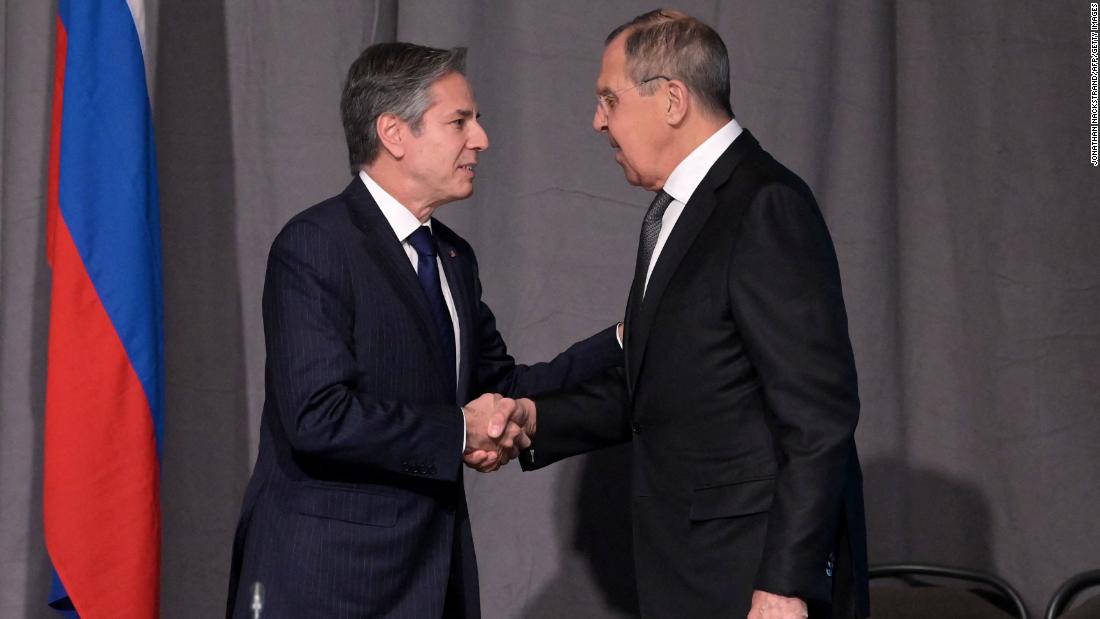
(CNN)US Secretary of State Antony Blinken and Russian Foreign Minister Sergey Lavrov met Thursday in Stockholm, Sweden, amid growing concern among Western powers that Russia is seeking to invade Ukraine.
The meeting between Blinken and Lavrov on the sidelines of the Organization for Security and Cooperation in Europe summit in Stockholm did not yield a concrete path forward, but both sides agreed to continue diplomatic conversations, a senior US State Department official told reporters traveling with the top US diplomat.
Blinken again "made clear that the United States and our allies are prepared to impose significant costs" if Moscow pursues military escalation, US State Department spokesperson Ned Price said in a written readout of the meeting.
Blinken said in a news conference after the meeting that he and Lavrov agreed to report the details of their meeting back to US President Joe Biden and Russian President Vladimir Putin respectively and that the two presidents "may have the opportunity to speak directly in the near future."
The engagement between the two top diplomats lasted about 40 minutes total, with the meeting itself lasting 30 minutes and Blinken and Lavrov speaking to the press for 10 minutes.
The meeting comes a day after Blinken issued the most forceful US warning yet to Russia about any attempt to destabilize or invade Ukraine. Blinken had warned that there will be "severe consequences" for any Russian military action in Ukraine and that the US would "respond resolutely, including with a range of high impact economic measures that we've refrained from using in the past."
Thursday's meeting did not result in any sort of specific agreement on ending the growing crisis, nor did Blinken explicitly lay out the "serious consequences" he has threatened if Russia invades Ukraine, according to the senior US State Department official.
The official, who described the meeting as sober and professional, said the meeting resulted in an agreement to continue diplomatic conversations and that the US was able to make clear their concerns about the Russian military buildup.
According to the State Department, Blinken "addressed Russia's aggression towards Ukraine, including its military movements near Ukraine's borders" and "reiterated the United States' call for Russia to pull back its forces and return to a peacetime posture" and to adhere to the 2015 Minsk agreements and a ceasefire in the Donbas region.
"He underscored that the best path forward is diplomacy in conjunction with the full implementation of the Minsk agreements, a process the United States is willing and ready to support," Price said in the readout.
The US and NATO say Russia is increasing the number of combat troops near its border with Ukraine, while the Kremlin has repeatedly denied that Russia plans to invade Ukraine and sees NATO support for the country as a threat on Russia's western border.
In his remarks to the press Thursday, Lavrov stressed that although Russia does "not want any conflicts" with NATO over Ukraine, it maintains the "right to choose ways to ensure its legitimate security interests."
"And let's not forget, of course, the proclaimed principle of indivisibility and security, including in the OSCE, in the NATO Council of Russia, which says that no one has the right to strengthen their security at the expense of the security of others," he said, also adding that "the further advance of NATO to the East will definitely affect the fundamental interests" of Russia's security.
The United States, meanwhile, warned again that there would be "serious consequences" if Russia engages to "pursue confrontation" with Ukraine.
On Thursday, Blinken told summit attendees that the US holds "deep concerns about Russia's plans for renewed aggression against Ukraine."
This aggression would "move us in exactly the opposite direction," Blinken said, stressing "it's simply not in anyone's interest."
He added that "the best way to avert the crisis is through diplomacy," calling on Russia to abide by the Minsk peace agreements hammered out in 2015 between Russia, Ukraine, France and Germany.
The interpretation of this and other core OSCE documents emerged as a sticking point between the two countries, with Lavrov saying it "is clear" that the US and Russia interpret them in "different ways."
Blinken criticized Russia's adherence to the Helsinki Final Act, a multilateral agreement dating back to 1975, saying that the country "continues to violate the Helsinki principles and repeatedly obstructs the work of this organization."
Despite the accusations, the two officials recognized the importance of dialogue, with Lavrov acknowledging "the importance of our two states for global stability and for security, including in the Euro-Atlantic area."
During their private meeting, other subjects like Iran and the Nagorno-Karabakh region were also raised, but there was no discussion of the Russia-backed coup alleged by Ukraine's president.
Price said Blinken raised the cases of two Americans detained in Russia -- Paul Whelan and Trevor Reed -- "and underscored the priority we attach to their prompt release."
"The Secretary and the Foreign Minister noted the importance of continued coordination on issues in the bilateral relationship and where interests are aligned, including when it comes to blocking Iran's pathways to a nuclear weapon," he said.
Blinken also held a bilateral meeting earlier Thursday with the Ukrainian Foreign Minister Dymtro Kuleba, at which the top US diplomat reiterated Washington's "unwavering commitment to Ukraine's territorial integrity, sovereignty and its independence."
The OSCE summit comes on the heels of a meeting of NATO foreign ministers in Latvia that was dominated by concerns over recent events in Belarus and Russia's intentions in Ukraine.
Speaking Wednesday after the meeting in Latvia, Blinken said the US and its NATO partners were prepared to impose costs for further Russian aggression against Ukraine and were preparing for "all contingencies" as Russia continues to make troubling moves.
While Blinken hasn't detail what those penalties will be, NATO Secretary General Jens Stoltenberg said in a Wednesday interview with CNN's Jim Sciutto that the alliance has "a wide range of options: economic sanctions, financial sanctions, political restrictions."
Putin called Wednesday for specific agreements that would rule out any further NATO expansion eastwards and deployment of its weaponry close to Russia's borders.
On Tuesday, Putin said NATO military expansion close to Russian borders and deploying missile systems in Ukraine would be crossing a "red line" for Russia. In response to the actions of the West that Russia perceives as a threat, the country is developing its own hypersonic missile weapons.
Blinken and Lavrov meet amid tensions over Russia's intentions in Ukraine - CNN
Read More


No comments:
Post a Comment